
HMAS SYDNEY II

In 1998 DMG was approached whilst conducting a display, to quote on a model of the WW2 Light Cruiser, HMAS SYDNEYII. The original Sydney was lost with all hands on the 19/20th of November 1941 following a vicious firefight with the German Merchant Raider “HSK KORMORAN” and found on the ocean floor off the West Australian Coast, near the KORMORANT in March, 2008.
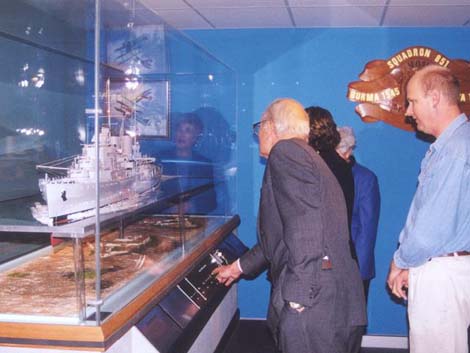
A proposal for the model was formulated with many working features making it an interactive model for visitors to the Australian Museum of Flight at HMAS ALBATROSS, at Nowra, NSW (Formerly the Naval Aviation Museum).
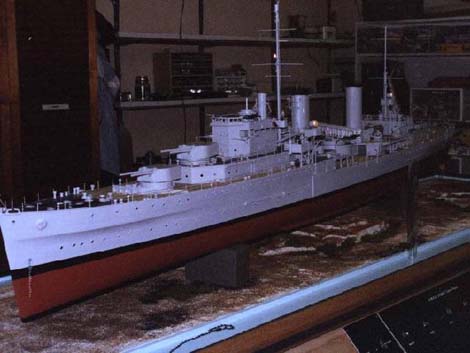
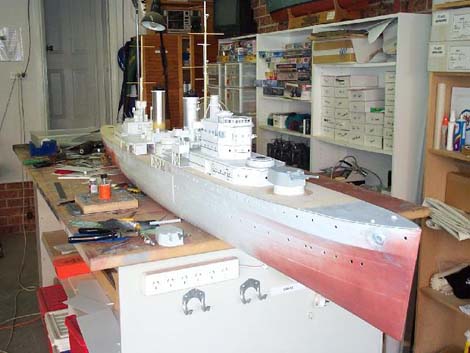
Research was first conducted through the National Archives in Canberra and several books written about the ill-fated SYDNEY. The model was to be constructed as she was when serving in the Mediterranean Sea in 1940. The model took many months to research as information and plans were scarce (Being an English built ship prior to WW2).
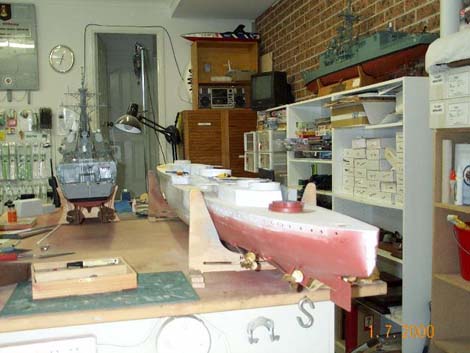
The model was to be built from the ground up, but thanks to several friends, one of which had a hull in the appropriate scale, very nearly completed, a fibre-glass hull was constructed from this.
Electronics were planned and supplied by Wireless Technologies and the model was set into place in May 2001. The model was supplied in a large display case (over 2.7 meters in length, 0.75 metres wide and 1.1 meters high) with a base and operating consul along the front. The model also included an operating sound system for commentary and sound effects.
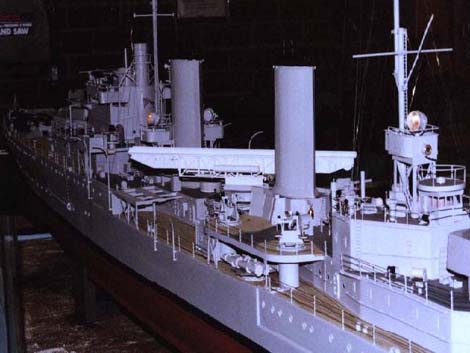
Operating features include rotating and elevating guns and fire control system, gunfire sounds, operating torpedo tubes with torpedo and sound effects. The anchor winch lowers and then raises the anchor from the seabed. An operating “Walrus” aircraft on which the catapult rotates, the aircraft starts, runs out to the end of the catapult all with sound effects, then shuts down and returns to it’s stowed position.
The four propellers rotate at slow speed and the rudder and crane can be rotated. All navigation lights and search lights operate and a key on the consul enable visitors to send out a message by Morse code on signal lamps on the bridge. All features are controlled by a microprocessor developed for the model.
The model is part of the large and varied displays at the fine Australian Naval Aviation Museum, Nowra, NSW. The museum is well worth a visit. 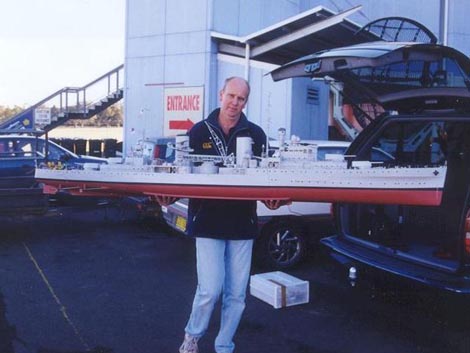









About Post Author
